
For Parents
School Aims
At Fair Isle Primary School we are committed to enabling all children from 3 – 12 to become:
- Successful Learners
- Confident Individuals
- Responsible Citizens
- Effective Contributors
Curriculum
To make use of regional and national guidelines to ensure a broad and balanced curriculum that provides children with the best possible learning opportunities and experiences.
Attainment
To provide a learning environment that is suited to the needs of each individual child and which aims to raise attainment across the curriculum.
Learning and Teaching
To provide a variety of learning opportunities and teaching styles to enable children to enjoy their education and develop positive attitudes towards learning within a calm, positive and safe learning environment that promotes good behaviour, self-discipline and respect for others.
To provide an environment where children and staff value high standards in all areas.
Support for Learning
To provide effective support systems which promote personal and social development and underpin academic achievement for all children.
To liase with outside agencies, wherever necessary.
To ensure good health in all children through strategies which promote physical and mental well-being and self esteem.
Ethos
To provide a welcoming, safe and caring environment in which every child is valued, respected and supported and to provide equal opportunities for all.
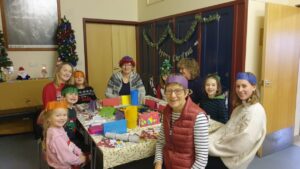
To make the school the focal point of the community through shared involvement in school life by children, parents, school staff and community members.
To encourage children to take some responsibility for their school, community and environment.
Resource Management
To improve the quality of learning and teaching through the effective organisation and management of the school’s resources, including staff.
Professional Development
To improve the quality of educational experiences for children by promoting the continual training, professional development and evaluation of the skills of all staff.
Values and Citizenship
To promote the values, attitudes and respect for others which will enable our children to become responsible citizens.
Written in October 2006 by School Board members and Headteacher (LG, FM, HS, MW, GH)
Present School Roll (06-07)
Primary 1 - 2 children
Primary 2 - 0 children
Primary 3 - 2 children
Primary 4 - 0 children
Primary 5 - 0 children
Primary 6 - 1 child
Primary 7 - 1 child
Staff: |
Mrs Ruth Stout |
Principal Teacher |
Mrs Mary Wilson |
Nursery Teacher |
|
ASN Teacher |
||
Ms Lise Sinclair |
Music Instructor. |
|
Mr Dave Wheeler |
I.C.T. Instructor. |
|
Mrs Pat Thomson |
Classroom Assistant |
|
Mr Malachy Tallack |
Classroom Assistant |
|
Ms Mati Ventrillon |
Secretary |
|
Ms Sue Hutchinson |
School Cook |
|
Mrs Pat Thomson |
Lunchtime Supervisor |
|
|
School Cleaner |
Parent Council : |
Chair |
Hollie Shaw |
Vice-chair |
Lise Sinclair |
|
Parent members |
Iain Stout |
|
Ian Best |
||
Co-opted members |
Stewart Thomson |
|
Fiona Mitchell |
||
Staff Member |
Mary Wilson |
|
Clerk |
Ms Mati Ventrillon |
Updated March 2007
The School
Fair Isle Primary is a small, one teacher school situated in the centre of the island. It is a non-denominational school. The school has a small office, the Old Classroom, the New Classroom and a large, bright nursery class There is access and toilet facility for disabled. The school has use of the connecting community hall for PE, the kitchen/committee room for school meals and toilets. The main school entrance is past the community hall car park and there is a bicycle shed and store beside it.
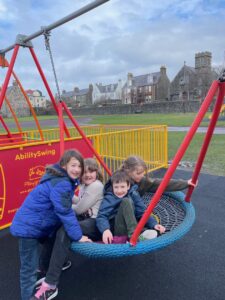
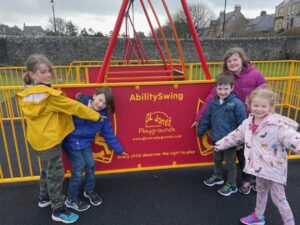
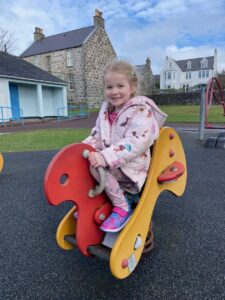
The playground is accessed by the door near the office, from the emergency exit door or by the side gate, which is also used by the community. Besides the tarmac area there are swings and climbing play equipment, which the pupils can use at lunchtime when they are supervised.
The re is an established garden within the playground and the new Eco School garden is to the south of the main playground.
The Curriculum
The curriculum of the primary school follows the 5-15 guidelines as required by the Scottish Office, in the curricular areas of English Language, Mathematics, Environmental Studies, Religious and Moral Education and Expressive Arts. French, Health Education, Science and Technology are also taught.
The School Development Plan takes into account the Five National Priorities: -
- Achievement and Attainment
- Framework for Learning
- Inclusion and Equality
- Values and Citizenship
- Learning for Life
The S.D.P. also takes into account S.I.C. priorities as well as the principles of Assessment is for Learning and the Curriculum for Excellence.
Language and Literacy
Through our language programme we hope to provide our pupils with the necessary skills to enable them to communicate effectively both orally and in writing. Reading, writing, talking and listening are equally important aspects of language work and other curricular areas provide a context for pupils to practise their language skills.
The reading scheme used throughout the school is the Oxford Reading Tree.
Novel studies promote higher order reading skills and the school has an excellent stock of fiction group novels. Pupils are encouraged to do personal research using library books.
In writing, children are given the opportunity to write in a variety of forms and for various purposes. Each week the pupils write the front page of the Fair Isle Times. They all have supervised access to the Internet and send and receive e-mails.
The children are aware that their writing has to be able to be read by others and so punctuation, grammar, spelling and handwriting are systematically taught. All pupils also have the opportunity to use word processors for written work.
French
All children are taught French, with P6 and P7 following an agreed syllabus that will equip them with the necessary skills they will need when they start at the Anderson High School. There is good support from the high school and we use the Metro scheme.
Dialect
Fair Isle Primary tries to promote Dialect teaching when possible. For example by encouraging the use of dialect words in personal writing and by providing opportunities to hear stories in dialect from visiting speakers.
Mathematics.
Mathematics is taught throughout the school. Much of the learning is through direct teaching and through the experience of handling materials in practical activities. We use Scottish Heinemann Mathematics as our core scheme and this is introduced when a child is ready to work independently in workbooks. Calculators and computer software are used as resources for learning mathematics and mathematics is linked with other subject areas where appropriate.
The 5-14 Guidelines on Maths identify different aspects: -
Information Handling, Number, Money, Measurement, Shape, Position and Movement, Problem Solving and Mental Maths.
Information Technology
The school has three computers, two of which have internet access and there are also four Alpha Smart laptops, which are used extensively across the age range. Children are taught to use the internet safely and all have their own email addresses. There is a digital camera and digital video camera and they are used to enhance children’s learning.
Religious and Moral Education
Religious and moral education is taught from Primary 1, in line with the school’s statutory obligations and is non-sectarian. There is a rolling programme for coverage of the curriculum.
Parents can, without prejudice to any other aspect of their education, opt to withdraw their child from Religious and Moral Education.
Expressive Arts
Included in this category are Physical Education, Music, Art and Craft and Drama.
Fair Isle School is fortunate to have an instructor for Music. Older pupils also have the opportunity for individual music tuition and currently may choose to learn fiddle, piano, flute or percussion.
All the pupils have PE twice per week and Music once per week.
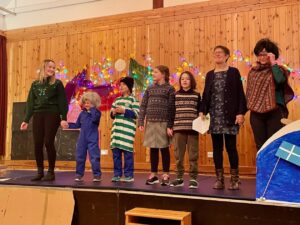
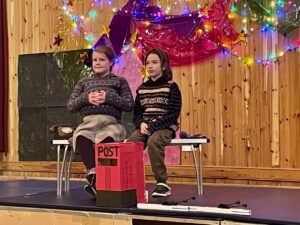
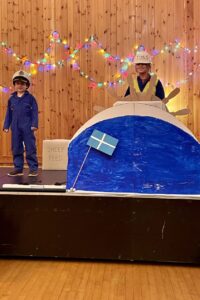
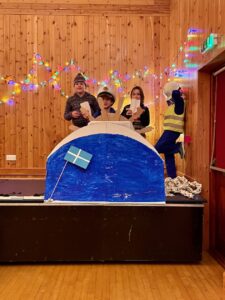
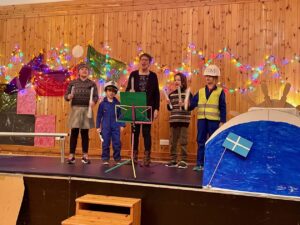
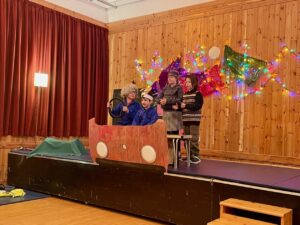
Drama mainly consists of performances for the community at different times of the year. During the last few years children have been involved in Drama trips where they have linked with other Outer Isles schools.
There is a rolling programme of art skills and education, as well as seasonal and topic related work.
Environmental Studies.
The components of Environmental Studies are: -
- Social subjects
- Science
- Technology
These subjects are usually incorporated in topic work for which there is a four-year rolling programme. This ensures that younger children will revisit a topic that they have studied when there are in the upper stage of the school.
When appropriate the children go on visits to gather information at first hand or people with special skills or knowledge are invited into the school.
The pupils are encouraged to find out information for themselves and to record this by writing out notes, drawing, giving talks, drawing plans and graphs, making models and carrying out experiments. We use TV and educational visits in order to widen their experience.
Health Education
Health Education is concerned with safe and healthy living. The children undertake a drug awareness programme and the older children have sex education as part of the health education programme.
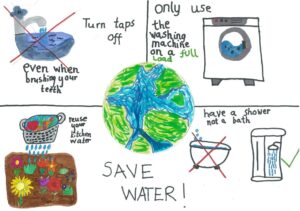
Eco School and Enterprise
These are integral to our school ethos and are planned as part of the whole school cyclic planning.
School Meals
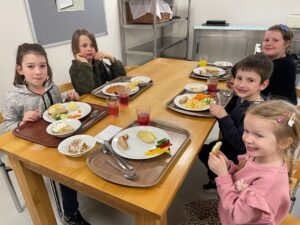
Two course meals are provided at the current cost of £1.30 (August 2006). Children can take their own packed lunch and would receive the same supervision as pupils taking school meals. Payment for school meals should be made at the end of each 4-week period or before a holiday break. Cheques should be made payable to ‘Post Office Ltd’.
Any parents who consider that their child may qualify for free school meals can apply. Application forms can be had from the school or from the Education Office, Hayfield House, Hayfield Lane, and Lerwick. Forms should be returned to the Education Office.
Milk is also provided at a cost of 27 pence per week and there is fruit for all children on Wednesdays, Thursdays and Fridays.
Communication between Home and School
Contact with parents is very important and you are welcome to call at the school after 3pm. any afternoon when the teacher will be free to talk to you or make an appointment to suit.
Newsletters are sent home regularly and occasionally additional information is posted in the shop.
During the year parents are invited to school to discuss their child’s progress and to see their work. Prior to the parents’ evening in June, Pupil Progress reports will be issued.
Assessment & Reporting
The assessment of pupils is a continuous process. The main means of assessment are by observation, by oral questioning and by examining written work.
National Tests are also used when the teacher thinks the child is ready. Tests are in Reading, Writing and Mathematics and these can be given at any time in the year. The teacher selects the test and level she thinks is most suitable for your child.
Level A –should be attainable in the course of pr.1-3 by almost all pupils.
Level B – should be attainable by some pupils in pr.3 or earlier but by most in pr.4.
Level C – should be attainable by most pupils in pr.4-6
Level D – should be attained by some pupils in pr5-6 or earlier but by most in pr.7
Level E – should be attainable by some pupils in pr.7-S1 but by most in S2
Where a pupil is experiencing difficulty they can receive help from the Learning Support Teacher. A meeting between the teacher and parents is arranged so as to discuss how best to support the child. Where further resources or assessment are thought necessary it is possible to obtain advice from the psychological service.
Homework
Homework is an important link between school and home. Parents should check whether their child has homework, supervise it and sign the homework diary. Homework should generally not last more than 30 minutes a night.
The homework policy was reviewed by staff and parents in October 2004 and is available on request.
School Rules & Discipline
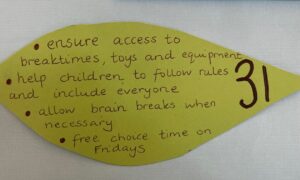
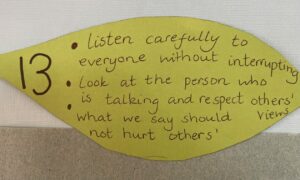
Rules and codes of discipline are set for your child’s safety and to allow the school a calm, happy atmosphere where pupils can learn. We try to encourage self-discipline and to establish an understanding of acceptable and unacceptable behaviour. Circle time is used as part of our PSD programme and to resolve any issues that arise.
Bullying
Any reports of bullying are taken seriously and if, on investigation, there is any evidence then appropriate action will be taken. The school reports twice yearly to the SIC on the number of reported incidents.
Enrolment
There is only one Primary 1 intake per year and it is at the start of the autumn term. Pre-school children whose fifth birthdays fall between 1st. March of the year of enrolment and the last day of February of the following year can be enrolled at school. Parents are entitled to defer their child’s entry to school for a further year if their child is not 5 when school opens in August.
The usual procedure for children starting school for the first time is for parents to visit the school and fill in the registration form in the first week after the Easter holiday then both parents and children are invited to school on the last week of term so that parents can have further information and the children can spend time in the class to help them settle when they join Primary 1 after the summer holiday.
Dress
There is no school uniform but children are expected to be clean, tidy and dressed appropriately.
If you feel you may qualify for a clothing grant please contact the Education Offices for advice.
PE
There is a planned programme of work in PE and includes athletics, games, dance and gymnastics.
Children have P.E. classes twice a week with a specialist teacher. Parents are asked to provide a T-shirt, shorts and gym/training shoes. It would be helpful if children could tie their own laces or have slip-on gym shoes or shoes with Velcro fastenings.
In the interests of safety, jewellery must not be worn and long hair should be tied back during P.E. lessons. Swimming trips are arranged for older children in Shetland and are usually part of a more general trip.
Attendance
It is the parents’ responsibility to ensure that their children attend school regularly. When a child is going to be absent a phone call to the school to explain the reason for the absence is appreciated. Parents should try and ensure they do not take their children out of school for a holiday during term time. If they choose to do so they can not expect the school to give work to their child over this period.
A good attendance is welcomed but children should not be sent to school if they are unwell. This is especially true if they are suffering from an illness, which may be transmitted to other children e.g. sickness, diarrhoea and coughs. It is unwise to send children to school if they have been ill during the night, as they will be tired and unable to cope with class work.
If a child becomes ill at school or if an accident occurs, the school will contact the parents immediately. In urgent cases the school may first contact the island community nurse then the parents.
Child Protection
The Headteacher is trained in Child Protection and staff are aware of procedures. If there is a suspected case of abuse or a disclosure the Headteacher will contact the Duty Social Worker.
Medicines
Children should not take medicines to school, as staff are not able to administer medicines to pupils.
In exceptional circumstances some staff can be trained to administer emergency medicine.
Children who require to use inhalers should be instructed by parents how to use the inhaler correctly.
Winter Emergencies
The following procedures will operate in bad weather: -
- In severe weather conditions you are strongly advised, for safety reasons, to keep your child at home.
- In blizzard conditions children will not be released from the building unless into the care of a responsible adult.
- Please collect your child as soon as possible if, during the day, weather conditions deteriorate.
Shetland Education Authority use SIBC radio to announce school closure and parents are advised to listen for announcements if the weather is poor.
Transfer to Secondary School.
Children completing their primary education at Fair Isle Primary usually transfer to the Anderson High School, Lerwick. A representative from Anderson High visits Fair Isle in the summer term to meet the P7 pupils and their parents. Then the pupils visit the Anderson High and stay in the hostel accommodation for an induction to the school.
Should you require further information on transfer to Secondary Education please contact the Head Teacher of either school.
The address of Anderson High is: -
Head Teacher
Anderson High School,
Twageos Road,
Lerwick,
ZE1 OBA
Tel. (01595) 692306
Leaving Fair Isle Primary
If your child is leaving Fair Isle Primary we would be grateful if you would inform the school. You should ask your new school to contact Fair Isle in order that your child’s records can be passed on directly from school to school.